See prices From 16.5 EUR · Free cancellation available
Contents
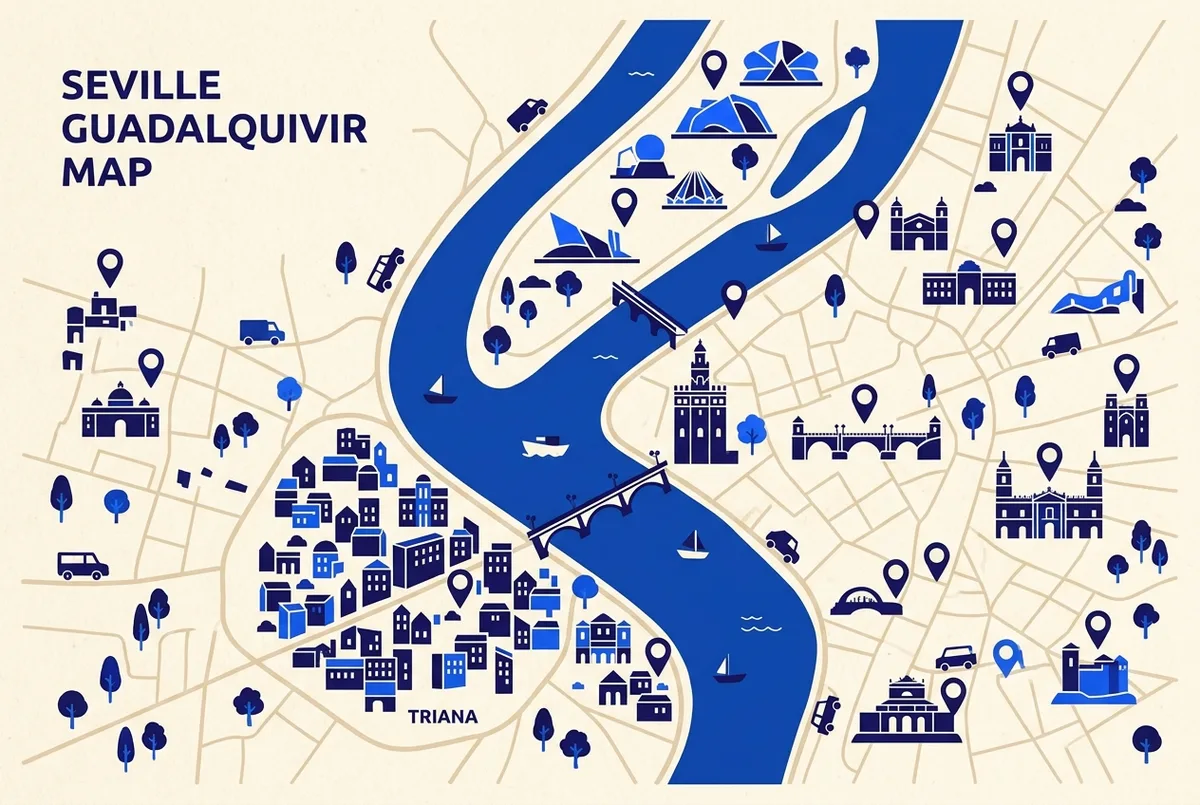
What are the main Guadalquivir river landmarks in Seville? Four things, in the order most cruises actually show them to you: the Torre del Oro watchtower guarding the old town side of the river, the Triana neighborhood and its ceramics facing it from across the water, the historic bridges you pass under between the two, and the Expo ‘92 pavilions further along toward La Cartuja. I’d read this page before you board, not after. Knowing what you’re looking at turns a pleasant hour on the water into something closer to a condensed history lesson, and you won’t need to lean over and ask the person next to you what that building is.
I wrote this as the single page I wished existed before my own first look at this stretch of river. Every cruise that runs here passes roughly the same landmarks in roughly the same order, so instead of scattering a sentence about each one across eight different tour descriptions, I’ve pulled them together here with their own deeper page each, in case one of them genuinely grabs your attention and you want more than a paragraph. Before any of that, it’s worth knowing that price and duration are really what separates one cruise from another on this river, not the view, since every boat passes the same landmarks, so see how all eight Guadalquivir river cruises compare before you pick one if you haven’t settled on a specific ticket yet.
What Will You Actually See on a Guadalquivir River Cruise?
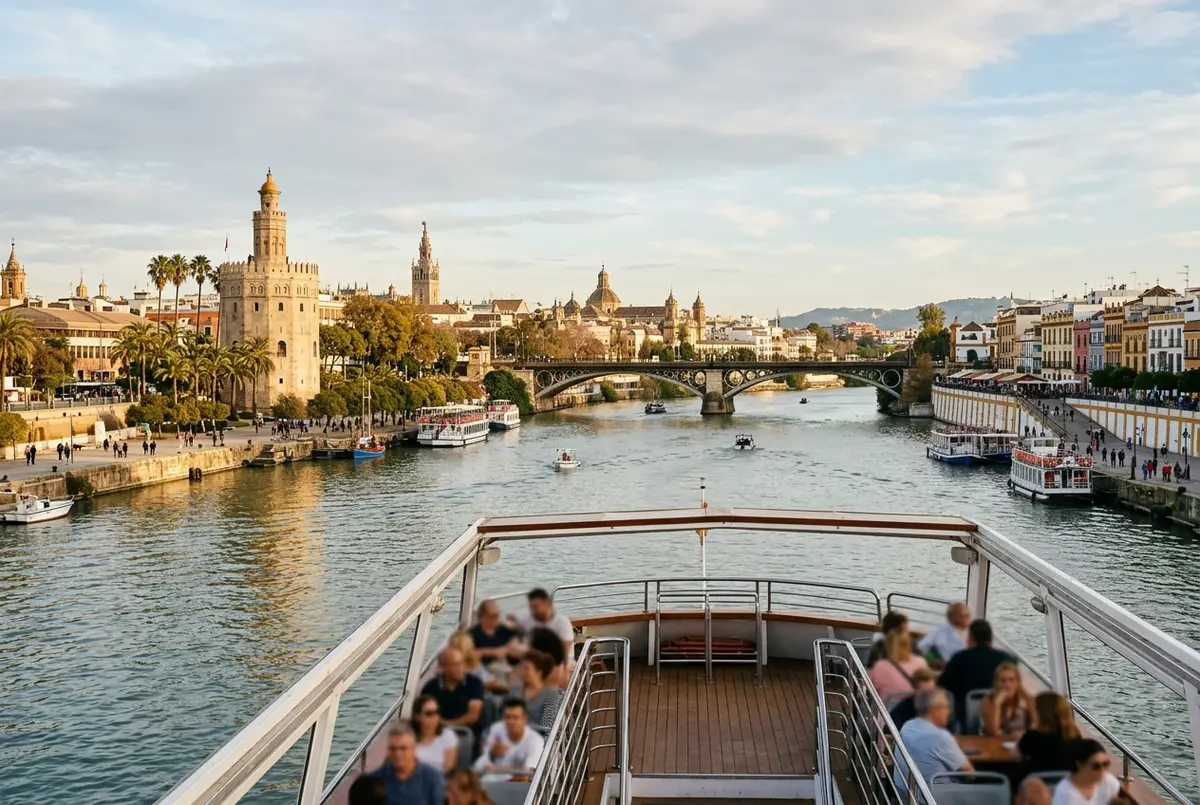
In order, heading out from the main departure docks near the old town: the Torre del Oro watchtower almost immediately, the Triana neighborhood and its ceramic facades across the water within the first few minutes, one or more historic bridges connecting the two banks, and, on the longer routes, the repurposed Expo ‘92 pavilions further toward La Cartuja. I’d say the first two show up on literally every product this site covers, while the bridges and the Expo site depend a bit on how far your specific cruise actually travels.
My honest take is that most visitors clock the tower and the bridges without really registering what they’re looking at, and that’s the exact gap I’m trying to close with this page.
I’d also say the river itself deserves a second of attention before you even get to the buildings on its banks. This is the same Guadalquivir that once carried ships bound for the Americas, and every landmark on this page sits on that history rather than beside it by coincidence. Knowing that context changes how a plain tower or an old bridge reads once you’re actually looking at it from a moving boat.
Check prices & dates
Ready to visit?
Book your tickets in advance: popular time slots sell out.
The Torre del Oro is the 13th century watchtower that still stands on the riverside promenade, and it’s also where most of the cruises on this site actually depart from, which is a convenient coincidence if you want to study it up close before boarding. The full history of the tower covers why it was built, why it’s named for gold, and what it’s used for today, but the short version I’d give a friend is this: it was part of the city’s river defenses long before anyone cared about photographs, and it’s the one landmark you genuinely cannot miss on any sightseeing cruise here.
I’d specifically recommend walking around it on foot before or after your cruise, since the view from the water only shows you one side of a tower that’s genuinely worth seeing up close too.
Triana: The Neighborhood Across the Water
Look to the opposite bank as the boat pulls away from the dock and you’re looking at Triana, the neighborhood that’s historically been home to Seville’s ceramics workshops, flamenco culture, and sailors heading out toward the Americas. The fuller picture of what Triana actually offers goes into the ceramics quarter and the riverside bar strip in more depth, but from the boat you’re mostly seeing rooftops, church towers, and the riverside promenade where locals genuinely hang out rather than a staged tourist backdrop.
I think Triana is the landmark most worth a return visit on foot, since a lot of what makes it interesting, the ceramic tile shopfronts and the smell of fried fish from a riverside bar, simply doesn’t translate from a moving boat a hundred meters offshore.
What Bridges Will You Pass Under?
The oldest and most photographed is the Puente de Triana, a 19th century ironwork bridge that was the first permanent crossing between the old town and Triana, and depending on your specific route you may also pass newer bridges built decades later. A closer look at the bridges themselves covers the ironwork detail and the story of why a city this old didn’t get a proper bridge until the 1850s, which genuinely surprised me the first time I read into it.
I’d slow down and actually look up at the ironwork as you pass under the Puente de Triana specifically, rather than just noting “bridge” and moving on, since the detail on the underside is honestly better than most people expect from a functional 19th century crossing.
The Expo ‘92 Pavilions Near La Cartuja
Further along the river, on the longer routes, you’ll pass a cluster of buildings that look distinctly different from the historic center: the leftover national pavilions from the 1992 World’s Fair, now repurposed as offices, a theme park, and exhibition space on Isla de la Cartuja. The full rundown of what’s still there and what it was built for explains why this stretch of riverbank suddenly looks like a different decade entirely, which is honestly one of the more jarring but interesting contrasts on the whole route.
I’d call this the landmark most visitors have genuinely never heard of before their cruise, and I think that’s exactly why it’s worth a paragraph of its own rather than a passing mention.
Why Do These Four Landmarks Matter More Than Everything Else Along the Bank?
Because they each represent a different chapter of how Seville actually grew up around this river, rather than just being scenery that happened to end up on the water. The Torre del Oro is the defensive, medieval chapter. Triana is the working class, trade and culture chapter, the neighborhood that built the boats and the ceramics rather than the one that financed them. The bridge is the 19th century chapter, the moment the city finally stopped relying on boats to cross its own river. The Expo ‘92 pavilions are the modern chapter, a single international event that reshaped a whole stretch of riverbank in a couple of years. I think that’s a more honest way to frame “what to see” than just listing buildings in the order the boat happens to pass them.
There are smaller things along the way too, the odd church tower, a handful of newer apartment blocks, the occasional rowing club, but I wouldn’t spend much mental energy on those. They’re filler between the four landmarks that actually carry the story.
Does the Order of Landmarks Change Depending on Which Cruise You Book?
A little, yes. The plain sightseeing cruises and the guided tour mostly run the same core stretch past the Torre del Oro, Triana, and the Puente de Triana, while the longer private electric boat ride and some of the special experience products push further toward La Cartuja and the Expo ‘92 site. I would not assume every ticket shows you every landmark on this page, the shorter, cheaper options understandably cover less river than the longer ones.
If seeing a specific landmark matters more to you than price, I’d check the route description on the individual product before booking rather than assuming.
Is There a Best Side of the Boat to Sit On for These Landmarks?
Mostly, yes, though it depends on your specific route. On the stretch past the Torre del Oro and Triana, the old town side gives you the tower and the historic skyline, while the opposite rail gives you Triana’s rooftops and the riverside bar strip along Calle Betis. I’d pick a seat near an open rail rather than fully enclosed seating if photos matter to you, since glass and reflections tend to ruin exactly the shots you’re trying to get of these landmarks.
My honest preference is the open side rather than a specific bank, since the boat usually gives you both views over the course of an hour anyway as it loops back.
Should You Read This Before or After Your Cruise?
Before, honestly, and I’d say that applies more to this page than almost anything else on this site. A tower, a bridge, or a cluster of old fairground buildings all look like generic scenery until you know what they are, and once you know, the same hour on the water reads completely differently. I wouldn’t wait until after your trip to look this up out of curiosity, since recognizing a landmark in the moment beats figuring it out later from a photo you can’t quite place.
Do Any of These Landmarks Connect to Each Other Directly?
In the sense that the river itself is the thread connecting all four, yes. The Torre del Oro once helped control access to the stretch of water the bridge now crosses, Triana sits on one bank of that same crossing, and the Expo ‘92 site further along used that same river frontage for an entirely different purpose centuries later. I’d say that’s the real value of seeing them in one cruise rather than researching each in isolation, you get a sense of how one stretch of water kept getting reused for a completely different purpose every few centuries.
I think that pattern, a defensive tower, then a trade and craft neighborhood, then a 19th century bridge, then a modern fairground, is a more interesting story than any single landmark tells on its own.
How Does This Compare to Just Walking the Riverbank Instead?
You’d see the Torre del Oro and the bridges either way, but walking misses the actual water level view that makes Triana’s rooftops and the Expo ‘92 site genuinely legible as a single stretch of riverbank rather than a series of disconnected sights. Whether a river cruise is actually worth it over a land based alternative is a question I’ve answered in more depth on a dedicated page, but my short answer is that the landmarks on this page specifically reward the water angle more than most Seville sightseeing does.
I would not skip walking Triana on foot separately, though, since the ceramics shops and the bar strip are things a boat simply can’t show you properly.
What If You Want to Combine This With a Day Trip?
These landmarks are strictly a Seville city activity, so they don’t compete with a day trip to somewhere like Córdoba or Ronda for your time, they’re more of an easy addition to a day you’re already spending in the city. The full lineup of realistic day trips from Seville is worth a look if you’re planning your whole stay and wondering where a river cruise should actually sit on the schedule.
I’d slot a river cruise into an evening after a day trip rather than the same morning, honestly, since you’ll likely be tired from travel and this is exactly the kind of low effort, sit down activity that works well at the end of a long day.
Do These Landmarks Look Different at Sunset Than at Midday?
Yes, genuinely, and I think it’s worth planning around if your schedule allows it. The Torre del Oro’s stonework picks up a warm color at golden hour that gives the tower its name a lot more credit than flat midday light does, and the Expo ‘92 pavilions, which can look faintly dated under harsh sun, read as more interesting against a softer evening sky. I’d pick a late afternoon or early evening departure over a midday one if the choice is purely about how good these landmarks look in your photos, though I wouldn’t call midday a bad choice either, just a flatter one.
Triana, honestly, holds up fine at any hour, since most of what makes it interesting is the shape of the rooftops and the density of the neighborhood rather than lighting specifically.
Is It Worth Taking a Guided Tour Just to Hear About These Landmarks?
If a live explanation matters to you more than a recorded one, yes, I’d say it’s worth the extra cost. A captain who actually narrates can point at the Torre del Oro or the bridge ironwork at the exact moment you’re passing it and answer a follow up question on the spot, which a broadcast audioguide simply can’t do. I wouldn’t call it essential, though, since this page already covers the same core facts a guide would mention, and a cheaper audioguided or recorded commentary cruise still gets you past every landmark on this list.
My honest take is that a live guide earns its price mostly through timing and interaction, not through secret information you can’t get anywhere else, and I think that’s a fair tradeoff to weigh against the extra cost.
My Honest Recommendation
I’d read this page once, then stop worrying about memorizing every detail and just enjoy recognizing the Torre del Oro, Triana, the bridge ironwork, and the Expo ‘92 buildings as they pass. None of these landmarks require advance tickets or research of their own, the boat does the work of bringing you past all four in roughly an hour. If one of them genuinely interests you beyond that, the deeper pages linked above go further than any onboard commentary will.
Frequently Asked Questions
What is the most famous landmark on the Guadalquivir river in Seville?
The Torre del Oro, the 13th century watchtower on the riverside promenade, is the most recognized and the one nearly every cruise passes close to.
Do all Guadalquivir river cruises pass the same landmarks?
Mostly, yes, for the Torre del Oro, Triana, and the main bridge, though only the longer routes reach the Expo ‘92 pavilions further toward La Cartuja.
Can you see these landmarks without taking a boat tour?
Yes, on foot along the riverside promenade, but the water level view genuinely changes how Triana’s rooftops and the bridges read as a connected stretch of river.
Is the Triana neighborhood worth visiting after seeing it from the boat?
Yes, I’d call it one of the better uses of a free afternoon in Seville, since the ceramics shops and riverside bars don’t come across from the water.
How long does it take to pass all four landmarks on a cruise?
About an hour on most sightseeing routes, though the shorter or more route-limited products may not reach the Expo ‘92 pavilions at all.
Do you need to know this history in advance to enjoy the cruise?
No, not at all, the cruise works fine as plain scenery if that’s all you want. I’d just say knowing the backstory turns the same hour into something you remember more clearly afterward, which is really the only reason I’d bother reading a page like this one before booking.
My honest bottom line: four landmarks, one river, and roughly an hour to see all of them from a seat that does the walking for you. I’d read the tower and Triana sections closely even if you skip the rest, since those two are the ones every single cruise on this river actually shows you.